
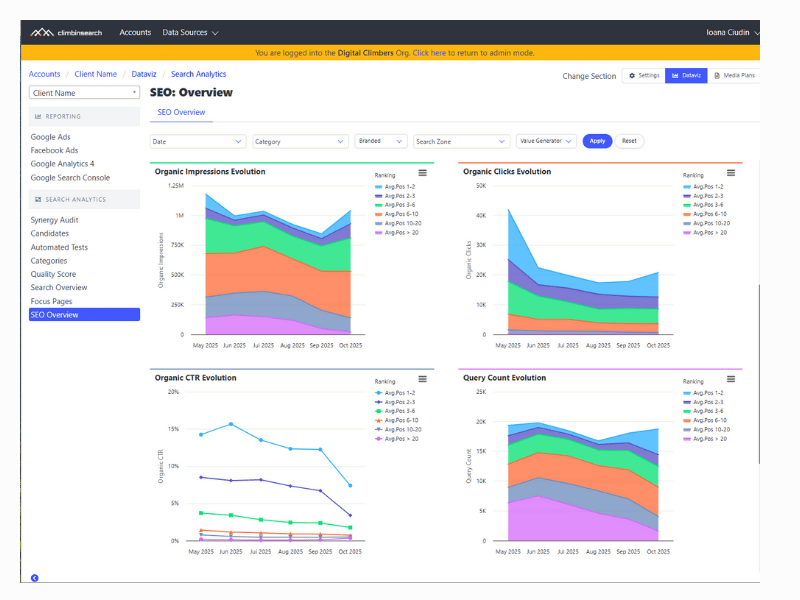
The top three organic positions capture the majority of clicks. Positions lower on the first page generate impressions but very few interactions.
🪄 traffic comes from clicks, not impressions
🪄 CTR increases dramatically from positions 6 to 3 and from 3 to 1
🪄 rankings below page one have almost no search visibility
Achieving top positions is the most direct way to increase relevant organic traffic.
You start by defining the goal and how success will be measured. Typical goals include:
🪄 increasing relevant organic traffic
🪄 increasing traffic for specific categories
🪄 improving visibility for a specific journey stage
🪄 increasing SEO ROI through queries with proven conversion rates
Once the goal is clear, the strategy becomes a data selection exercise based on volumes, impressions, rankings, CTR, and search potential.
Paid Search offers immediate visibility and control through budgets and bidding.
Organic Search provides long term visibility based on trust, relevance, and authority.
Users do not really distinguish between them. They click what appears relevant and visible.
There are five core data points:
🪄 number of search queries
🪄 search volumes per query
🪄 impressions (visibility)
🪄 average position
🪄 clicks
Organic growth is driven by influencing impressions and clicks through ranking improvement.
Because visibility at those positions is still almost zero. The real impact comes from moving:
🪄 positions 16 to 6
🪄 positions 6 to 3
🪄 positions 3 to 1
These shifts deliver visibility, CTR, and measurable traffic.
The fastest wins come from segments with realistic movement potential:
🪄 position 6 to 10
🪄 position 3 to 6
🪄 position 1.5 to 3
Inside ClimbinSearch, you sort these segments by impressions, SEA indicators, cost, conversions, or revenue. If a query is important in SEA, it usually deserves attention in SEO.
You need categorization. All queries must be segmented by category so you can build targeted SEO plans.
ClimbinSearch offers:
🪄 default categorization
🪄 rule based categorization
🪄 AI trained categorization aligned with annual media investments
Once the category is defined, you simply apply the same growth logic but filtered on that category.
This requires segmenting all queries by CDJ step:
🪄 awareness
🪄 consideration
🪄 purchase
ClimbinSearch does not automatically classify CDJ, but CDJ mapping can be added in the business insights enrichment phase using rules.
Once CDJ is mapped, you apply the same optimization logic within that stage.
This combines the two prerequisites:
🪄 correct categorization
🪄 CDJ mapping
Then you filter the data and apply the same ranking and impression based approach for the chosen intersection.
SEO ROI focuses on queries with:
🪄 transactions
🪄 revenue
🪄 strong conversion rates
ClimbinSearch has a dedicated SEO ROI dashboard that:
🪄 compares keyword profitability across SEA and SEO
🪄 uses paid search conversion rates as a proxy for organic
🪄 identifies high value queries to target
This requires its own methodology and deserves a separate article.
If your goal is relevant traffic, select queries from strong potential segments (position 6 to 3 to 1) and sort by impressions. Improving these rankings yields fast results.
CTR data typically shows:
🪄 2x more clicks at positions 1-2 than 2-3
🪄 2x more clicks at 2-3 than 3-6
This pattern is consistent across most websites.
By applying the Build Measure Learn loop continuously.
Define a hypothesis. It must be specific.
Example:
Publishing five off page articles in selected publications may improve category rankings and increase traffic by thirty percent.
Plans should fit into one month or one quarter so you can measure impact.
You define exactly what changes you are testing and monitor the impact through ClimbinSearch dashboards:
🪄 selected queries
🪄 landing pages
🪄 categories
🪄 semantic visibility
Measuring quickly shows whether the hypothesis holds true.
The goal is progress, not perfection.
🪄 successful tests show what works
🪄 failed tests show what to avoid
🪄 both guide smarter decisions
Incremental improvements performed consistently have the largest long term impact.