
🪢 What does maximizing Search ROI actually mean?
It means using your SEA budget only where it delivers incremental results, while letting organic take the lead where visibility is already strong.
🪄 invest SEA in low visibility organic areas
🪄 redirect budget from overlapping queries
🪄 increase organic CTR and clicks
🪄 lift total combined performance
It is the balance of cost efficiency and growth.
🪢 What are the 4 steps to maximize Search ROI?
The process is simple, structured, and easy to follow:
🪄 Step 1: Setup and Initial Pre Audit
🪄 Step 2: Business Insights Enrichment
🪄 Step 3: Build Tests for Incremental Growth
🪄 Step 4: Monthly Measure and Learn
Each step creates clarity and leads to better performance.
🪢 What happens in the Setup and Initial Pre Audit?
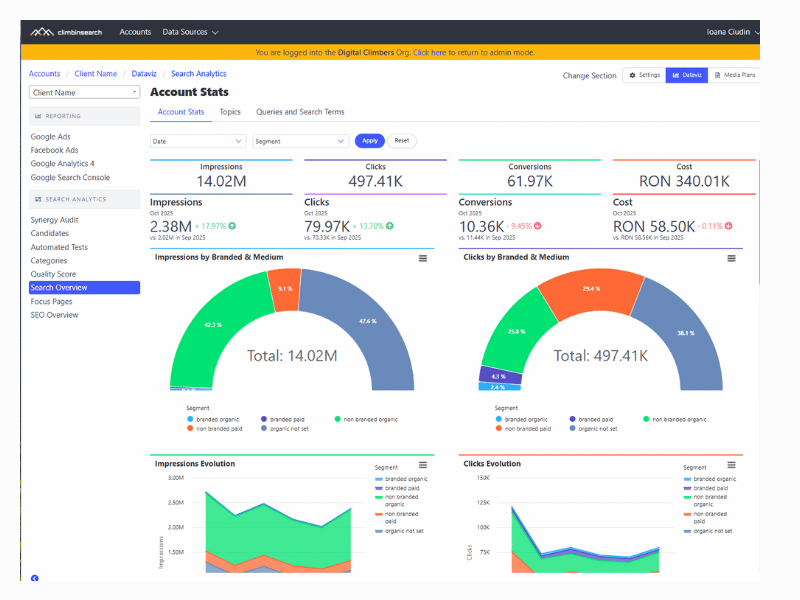
In this step you consolidate Organic Search and Paid Search into one data set.
Within hours you can see:
🪄 visibility across branded and non branded queries
🪄 visibility gaps between paid and organic
🪄 automatic categorization of user searches
🪄 category visibility across both channels
🪄 all SEA, SEO, and synergy visualizations
You just connect Google Ads and Google Search Console, then read the dashboards.
🪢 What is Business Insights Enrichment?
This step makes the system personal to your business reality.
Based on the insights, new ideas naturally appear:
🪄 define and monitor the user decision journey
🪄 apply personalized categorization
🪄 create custom focus queries
🪄 create category based analysis
🪄 align segmentation with media investments
Most brands choose to segment their entire search universe exactly as media budgets are split.
🪢 How do you build tests for incremental growth?
This is where the always on approach starts.
The system generates test ideas automatically based on performance patterns.
You prioritize them with your SEO and SEA teams.
Typical test types include:
🪄 automatic SEA SEO cannibalization tests via API
🪄 landing page alignment tests
🪄 SEO uplift tests for categories with high SEA spend
🪄 enrichment tests for keywords missing in SEA
You only need time and focus. The system does the operational part.
🪢 What happens in Monthly Measure and Learn?
You use ready to read monthly reports that show:
🪄 search synergy progress
🪄 category evolution
🪄 branded and non branded growth
🪄 test results
🪄 incremental performance
You can also opt in for analytics consultancy hours to transfer the know how into your team, or expand to full ClimbinSearch reporting across Google Ads, Search Console, Chrome API, Google Analytics, Facebook Ads, or other sources.
🪢 Why does this process work?
Because it combines three layers:
🪄 technology
🪄 know how
🪄 strategy
You get automation for the repetitive work, clear dashboards for insights, and a structured process for continuous improvement.
🪢 Why do we need a unified SEO and SEA data set?
Because you cannot make accurate decisions with fragmented information.
Combining data creates a single source of truth with:
🪄 branded and non branded split
🪄 category visibility
🪄 paid and organic gaps
🪄 cannibalization indicators
🪄 synergy signals
This foundation makes every decision clearer.
🪢 Is SEO SEA synergy a myth?
Not at all.
SERP has many slots. Some are paid, some are organic. Covering more visible slots increases CTR.
But you must control cannibalization to avoid paying for traffic you could earn organically for free.
🪄 high visibility strategy
🪄 budget efficiency strategy
Both are correct depending on your objectives.
🪢 What is the impact of reducing cannibalization?
Reducing cannibalization brings:
🪄 higher organic CTR
🪄 more organic clicks
🪄 incremental combined growth
After testing dozens of cases, we developed automatic daily synergy tests that optimize SEA budgets, grow organic CTR, and improve total search performance.
🪢 Who benefits the most from this 4 step ROI process?
🪄 multi brand teams
🪄 multi country teams
🪄 businesses with large search universes
🪄 agencies managing multiple portfolios
🪄 brands with strong SEA spend
🪄 brands with categories lacking organic visibility
Anyone who wants structured, predictable, incremental search growth.
🪢 How can I create an organic and paid search synergy strategy?
🪄 Define business goals
🪄 Map the search universe
🪄 Identify overlap between SEO and PPC
🪄 Reduce cannibalization
🪄 Align landing pages and ad messaging
🪄 Improve technical SEO
🪄 Share data across teams
🪄 Track paid and organic together
🪄 Test continuously
Tools like ClimbinSearch simplify this process.